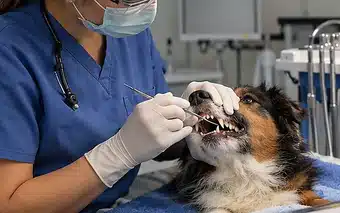
Accidental tooth injury
Policy evidence to find
Trauma definition, affected teeth and chewing restrictions
Limit or allowance to check
Medical limit and any dental sublimit
Trade-off
Trauma cover alone does not resolve illness

Compare dental accident, dental illness, cleaning and preventive benefits using documents, invoice components and realistic allowance use.
Use these checkpoints to frame the literal question before reading the full guide.
The best pet insurance including dental depends on which dental expense you want help with. Compare accidental tooth injury, dental illness, routine cleaning and preventive products separately. A plan can include one category while restricting another. This guide audits the evidence and trade-offs; it does not name a universal winner or rank plans without matched quotes.
The sections below show how to verify the answer and what can change it.
Retrieve the dental clause, general exclusions, selected benefits and any routine-care schedule. Put the pet’s dental history beside them. AVMA explains that periodontal assessment may involve dental cleaning and radiographs to determine disease severity. That clinical need does not establish insurance eligibility, so ask for an itemized estimate and map the services individually.

| Dental need | Policy evidence to find | Limit or allowance to check | Trade-off |
|---|---|---|---|
| Accidental tooth injury | Trauma definition, affected teeth and chewing restrictions | Medical limit and any dental sublimit | Trauma cover alone does not resolve illness |
| Dental illness | Periodontal, resorption and other named-condition terms | Medical benefit and treatment restrictions | Prior symptoms or required care may matter |
| Routine cleaning | Explicit cleaning benefit or routine schedule | Cleaning line, shared allowance and unused balance | A capped routine benefit is not major-treatment protection |
| Preventive care | Listed eligible products or services | Category allowance and exclusions | Count only items the pet will actually use |
A concrete audit example is the currently linked Alabama Pets Best specimen, section 6. It treats periodontal procedures and traumatic fractures separately and excludes prophylaxis with associated costs. Endodontic treatment is restricted by tooth type. Those are observations about that identified specimen, not a verdict on a current individual offer or the entire brand.
An estimate headed “dental procedure” can contain both routine and therapeutic work. Ask the veterinarian to itemize the clinical services accurately, then ask the insurer to explain their classification. Do not ask the practice to relabel a preventive item as disease treatment. Keep the history and the planned work consistent in every document.
Keep policy terms, deductible, reimbursement and limits beside the quote so the comparison stays consistent.
Consider invented routine options. Option R costs $240 a year and offers a $100 cleaning allowance plus other listed benefits. Option S costs $360 and offers $180 for cleaning plus different benefits. If the same planned eligible cleaning expense is $90, both provide at most $90 toward that line; the extra $80 advertised allowance in S adds nothing in this scenario. If the eligible cleaning expense is $250, R’s modeled contribution is $100 and S’s is $180. The $80 difference is still smaller than the $120 added annual cost before considering other services. These figures are hypothetical, not clinic prices or provider quotes.
The Pets Best routine-care page shows a $150 BestWellness line shared by spay/neuter and teeth cleaning, while EssentialWellness shows $0 for that line. State and pet-age variation is disclosed. Confirm the offered schedule and remaining shared amount; do not treat the website figure as a separate guaranteed cleaning benefit.
Give weight to trauma definitions, eligible procedures, retained costs and the medical limit. A cleaning allowance is secondary.
Audit illness restrictions, history requirements and maintenance conditions before scoring premiums.
Compare actual usable routine benefits with the added yearly cost. Do not confuse predictable care with protection against a large unforeseen bill.
The missing pieces are matched current quotes and the policy version applicable to a particular pet and state. Until those are available, a numerical winner would conceal uncertainty. A defensible selection identifies the exact dental job, shows the supporting clause and states which part of the estimate remains unfunded.
Not necessarily. Separate routine cleaning from injury and illness benefits and read the chosen schedule.
Only for a suitable use case, and only after considering the added cost, shared limits and other terms.
An invoice can combine covered and uncovered services. Ask how the policy treats and allocates associated costs.
These links provide independent government, academic or reference background. Actual policy wording controls insurance eligibility, benefits and claims.
Keep the policy terms beside the price, then continue to rates when the comparison is clear.